
 BlogLAMA2-Related Congenital Muscular Dystrophy: Understanding a Rare Genetic Disorder
LAMA2-Related Congenital Muscular Dystrophy: Understanding a Rare Genetic Disorder
2/4/2026
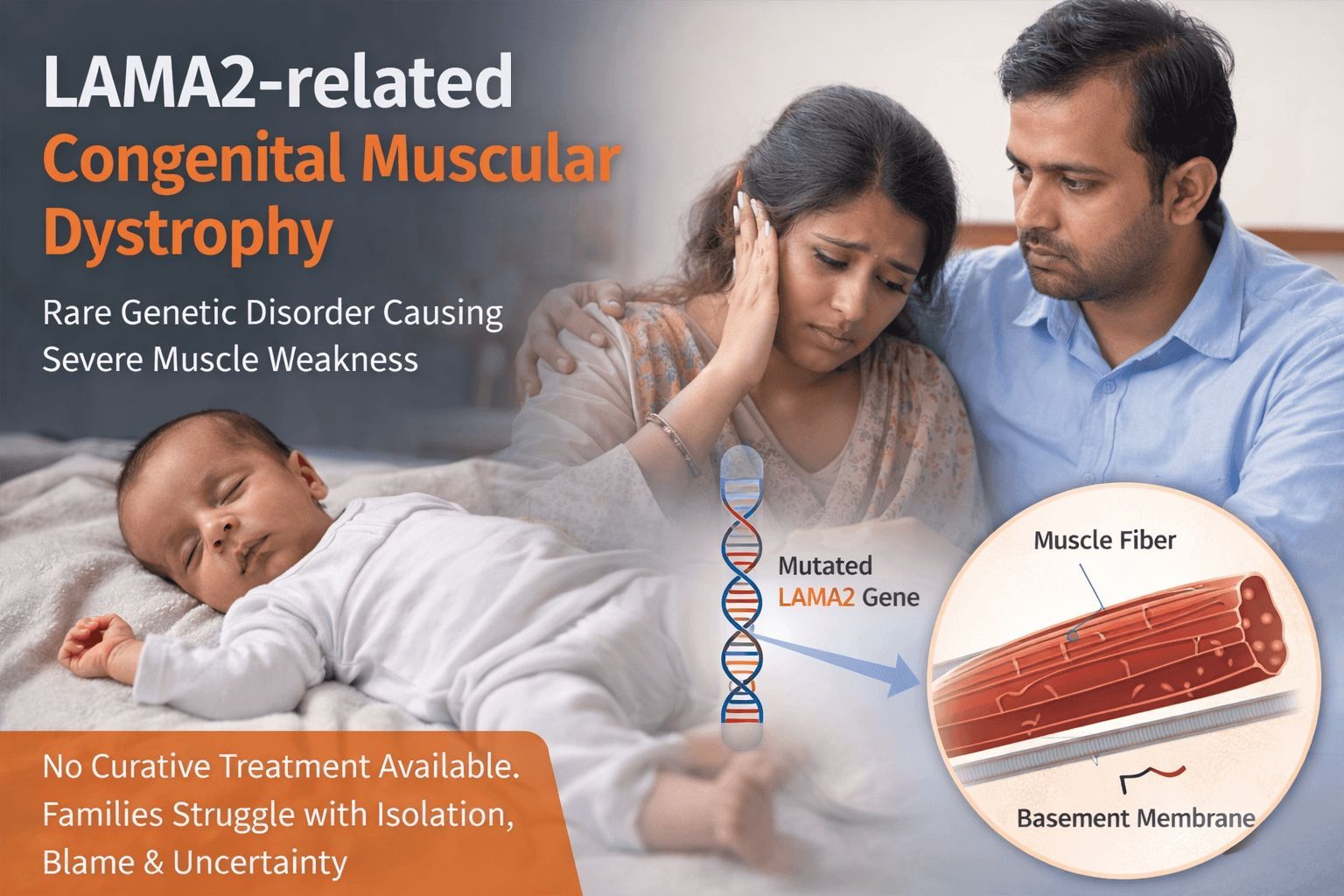
# LAMA2-related Congenital Muscular Dystrophy
When a newborn lies unusually floppy, struggles to feed, and barely moves, parents sense something is wrong. They visit pediatricians, then pediatric neurologists, and finally clinical geneticists. After many months, they finally hear the name of the condition: LAMA2-related Congenital Muscular Dystrophy. It usually comes with two painful realities — it is rare, and no curative treatment is available at present.
In India, where awareness about genetic diseases remains limited, such a diagnosis lands like a storm. Families don’t just wrestle with fear; they wrestle with blame and confusion. A deep sense of isolation often follows.
## The Role of the LAMA2 Gene
At the center of this disorder lies the LAMA2 gene, whose role is to produce merosin, a crucial part of the laminin-211 complex. Imagine each muscle cell as a brick wall. Merosin acts as the cement that anchors the wall to its foundation, known as the basement membrane.
Every time we move, stand, or even breathe, this bond keeps muscle fibers stable. When both copies of the LAMA2 gene are damaged due to mutations, the body cannot produce enough functional merosin. Without this anchoring glue, muscle fibers detach and degenerate over time. This constant cycle of injury and failed repair leads to the characteristic muscle weakness seen in LAMA2-CMD.
## Early Symptoms and Development
Symptoms usually appear in infancy. The baby may feel limp in the arms and struggle to lift the head. Feeding becomes difficult, and parents anxiously wait for milestones that never arrive. The cry may be weak, movements limited, and breathing sometimes labored.
Doctors may observe changes on brain scans, yet intelligence is almost always normal. These children understand, learn, and feel deeply. Their minds remain sharp even as their bodies struggle. In milder cases, where a small amount of merosin is present, walking may be possible for a few years before weakness gradually progresses.
## Physical Progression and Social Challenges
As months turn into years, physical challenges become more apparent. Joints stiffen, spines curve, and breathing muscles weaken, though the heart is usually unaffected. The child’s full awareness makes the disease especially painful to witness.
In India, families face not only medical but social challenges. Once the word genetic is mentioned, relatives may begin assigning blame. Mothers are often unfairly targeted. Science tells a different story — these are random DNA changes carried unknowingly by both parents. There is no fault, only biology.
## Current Treatment Limitations
Unfortunately, biology has yet to offer a cure. There is currently no FDA- or EMA-approved disease-modifying therapy for LAMA2-CMD. Care focuses on physiotherapy, nutritional support, and respiratory assistance to maintain comfort and quality of life.
Parents watch their children grow mentally but not physically, living with the heavy knowledge of what is wrong while lacking a medicine to fix it. Many describe it as standing outside a locked door, hearing their child’s strength fade on the other side.
## Research and Future Hope
Globally, research is moving with cautious optimism. A Japanese company, Modalis Therapeutics, is developing a gene modulation approach. Because the LAMA2 gene is too large for standard viral delivery, researchers are using CRISPR-based activation to turn on another gene, LAMA1.
LAMA1 produces a similar protein that can partially replace the function of merosin. In animal models, activating LAMA1 has improved muscle strength and reduced degeneration, suggesting that compensating for missing merosin may ease disease severity.
## The Need for Awareness and Empathy
For now, these therapies remain in the research phase and far from clinical use in India. Despite their physical limitations, children with LAMA2-CMD display remarkable emotional depth, intelligence, and resilience. They adapt, laugh, and dream.
Until science delivers a cure, families in India need empathy, awareness, and unity. Genetics should never divide families. It should remind us that every life — even a fragile one — is built from the same human code. Sometimes, understanding that truth is the first step toward healing.